
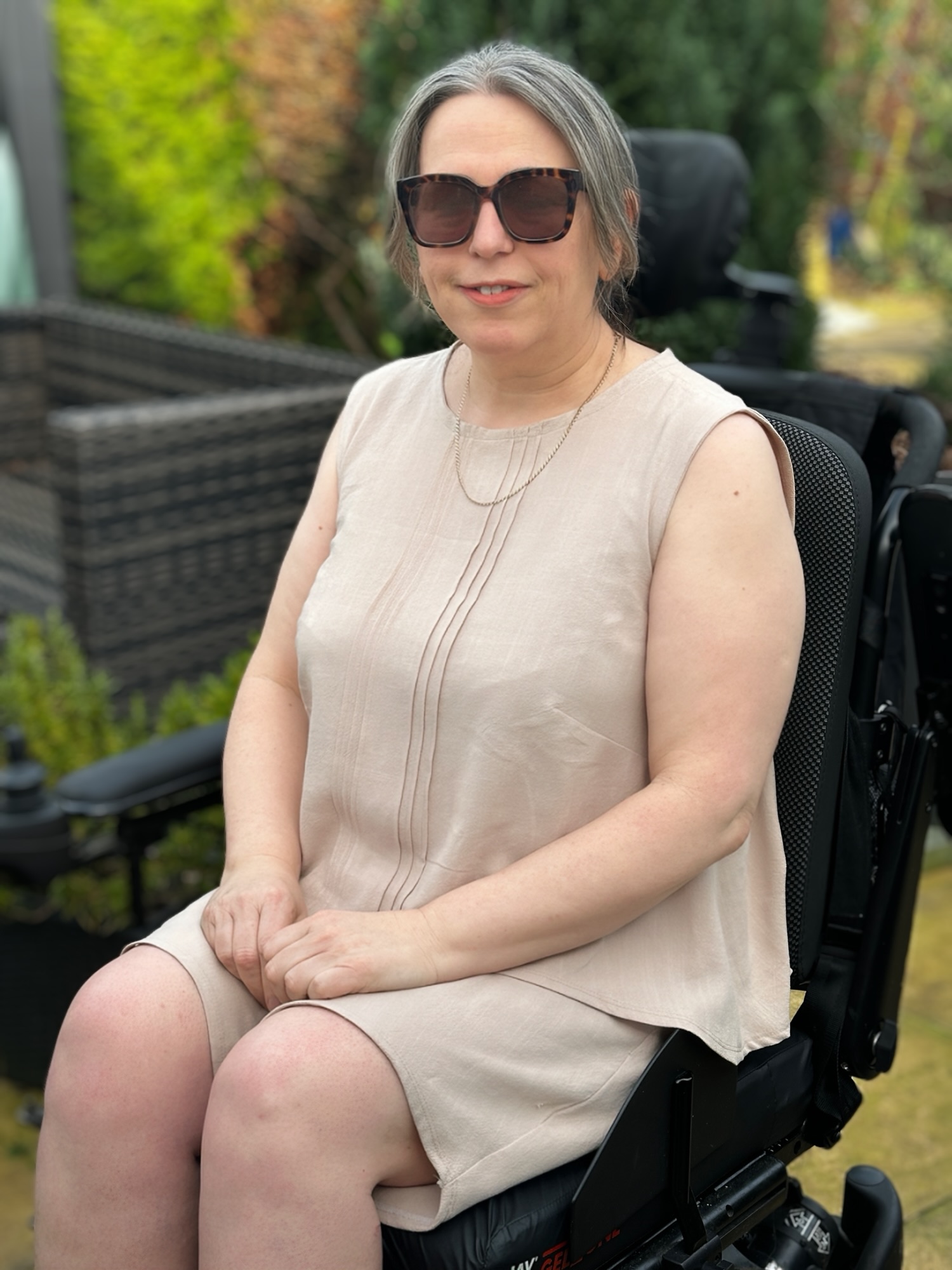

I have wanted to be able to design my own clothes ever since I was a little girl, and this has become increasingly more important to me as a wheelchair user. Most things that I make are from standard patterns designed for standing people, and so I have to adapt them to make them comfortable when I’m sat down in my chair. There are very few wheelchair-specific patterns out there, and from the ones that do exist, the majority are not the kind of clothes that I want to wear. Just because I use a wheelchair doesn’t mean that I want to constantly dress in tracksuit bottoms and hospital attire. It’s still important to me that I can look fashionable and attractive in my clothes.
So I’ve tentatively started down the path of designing and drafting my own. Starting with something reasonably simple. The most important consideration being that the set needs to be comfortable. Being seated means that I am more prone to pressure sores if a garment doesn’t fit correctly.
I can’t draw for toffee, so I kept my ideas in my head and then just added them into my block as I’m drafting. I’ve watched all of Izzy’s (From Minerva) pattern drafting videos and invested in a couple of pattern drafting books (Aldrich and Joseph Armstrong).
It has been such a tremendous learning curve for me flat drafting for the first time. I have to admit that I ended up resorting to some draping on the legs of the shorts as I just couldn’t get the fit correct otherwise. This is very much a first draft, and I intend to work on these designs until I have perfected them, but for a first attempt, I’m very pleased with them, and I’ll certainly be happy wearing them on my holiday. They are comfortable; I know the fit still needs tweaking, but I’m being very picky. If I’d picked these up in a shop, I’d have probably bought them and thought nothing of it.
I used a beautiful soft viscose linen from Minerva’s core range, which has all the wonderful cooling ability of linen but with the addition of viscose so it doesn’t crease quite so badly. The viscose makes this fabric feel really soft and so it is incredibly comfortable next to your skin.
My first error was not realising how differently this fabric behaves to the calico that I used for my toile. The calico is quite crisp, whereas the viscose linen is incredibly soft and drapey and so hugged my body differently. I also realised to my horror that the beautiful frappe colour is very close to my skin tone so from a distance you could be forgiven for thinking that I wasn’t actually wearing anything!
Shorts
I know from all my previous makes that if you try and sit down in standard shorts they will ride down at the back and dig in at the front so the first thing that I did was adjust the waistband to accommodate for this. I also played around with several crotch depths and points until I found one that I felt most comfortable with. Even with a comfortable crotch I still had folds of fabric in my lap so I used the method I came up with before when I made a pair of trousers of making a lap yoke and this enabled me to remove the excess fabric out through the seams. It didn’t seem to matter what I did with the legs, I was still struggling with creases and drag lines. It was at this point, in desperation I just undid the leg seams and started to drape. It was soooo much easier. I was able to see that I needed a dart in the side of the back leg at hip level and the side seams had to be bent to follow the contours of my seated shape. It looked completely odd when it was transferred back onto my 2D flat pattern but it seemed to work when it was in 3D on my body.
Top
I wanted to make a top that had a reasonably high neckline so that I felt comfortable being viewed from above and that although it would be sleeveless, wouldn’t expose any axillary tissue. I also wanted it to be close-fitting through the bust but then ease out at the sides to give a more pleasing silhouette. It was also important that I wasn’t sat on excess fabric.
This top was far easier to draft than the shorts as I was able to simply follow the instructions in my pattern drafting book to design it. The original block had darts at the shoulder, so I rotated these to be at the bust. I wanted to have some kind of feature on the front to try to draw attention away from my wheelchair and would’ve loved some embroidery here, but unfortunately, my machine was away being serviced, so I opted for some pin tucks instead. These were really easy to draft, and I’m very pleased with the result. I have to say that I’ll probably keep these next time I make the top. I wanted the top to have clean lines, so I opted for single-fold binding to finish the neck and arm holes. I drafted the hem to fit in my lap at the front and then graded down to seat level at the back. Now it’s finished and I have looked at my photo’s I think for next time I may trim the arm holes at the front a little.
I’ve really enjoyed this whole process. It’s definitely been challenging and certainly frustrating at times, but this has shown me a new side to my hobby, and I can’t wait to learn more and be able to bring some more of my ideas to life.


Image Description: (There are six images taken from different angles showing Yvonne sat in her wheelchair in her garden. She is wearing a self-drafted shorts and top set made with viscose linen in a frappe colour).
#MinervaBrandAmbassador , #MinervaMakes , #MinervaMakers , #MinervaExclusivePatterns , #MinervaCoreRangeFabric , #DisabledSewist , #IWearWhatISew , #SelfDrafted , #SewnShownSeated , #WheelchairSewingConsiderations , #AdaptiveFashion , #MarchSewOver50 , #SewOver50
Leave a Reply